26 February 2012

Norton Hulk vs. Bana Hulk - a comparison

With the upcoming Avengers flick the Hulk will smash across the silverscreen once again. A good time to look back on last two times the green giant roared in Hulk (2003) and The Incredible Hulk (2008). In short - Norton Hulk kicks Bana Hulk's butt.

The 2003 Ang Lee version puzzled the world - Ang Lee doing Marvel? The director did imbue film with his artistic sensibilities. Great visuals and a highly detailed character study, layered into the plot of Eric Bana becoming the Hulk and having to deal with it. There's a great deal of time spent on a new origin of it all, a father (Nick Nolte) who's experimented on his son. There's a layer of Betty having been on that very same base back then (don't you love a good coincidence?). Just so happens it was Betty's dad (yeah, you know who I'm talking about - Uber-General Thaddeus E. "Thunderbolt" Ross) fired Bruce Banner's dad back on the base.

The 2003 plot thickened ... eventually. It layered and layered, artistically taking its sweet time and it even gave it to us in stunning comic book colors and frames ... but unfortunately Ang Lee probably hasn't read too many comic books as a kid - the excitement, the clarity and the tempo of comic books seemed lost on him. Bana's Hulk barely had a chance to show up between all his artistic detail - and when he finally did, he got to fight poodles and, in the end, his own dad in a highly anti-climactic battle.

In 2008 The Incredible Hulk came along - apparently after some shifting and rewriting by Edward Norton himself. Louis Leterrier got to direct after his some studio execs clearly saw a fit between his Transporter style and what they had in mind for the new Hulk. The 2008 Hulk then is essentially more simple and more direct. When you think about it, this seems apt for a film about the Hulk. Leterrier and the writers did a far better job in cutting to the chase - and I don't mean that they went for the cheap "let's smash through the entire movie" way. Most of the film is about Bruce Banner actually trying NOT to become the Hulk and the plot is well crafted to plausibly get us into green giant mode. The aforementioned excitement, clarity and tempo I was missing in Ang Lee's Hulk - the 2008 version had it. I'm still not a huge fan of it but it does eat Ang Lee for breakfast.

The Hulks and their Banners: The 2003 version seems a bit more comicky, which one might assume is good. But in truth it made the Hulk less believable and he was all around too soft, too much of an intellectually tortured soul and too little of the green mountain of muscles reacting purely from his instinct brain. The 2008 Hulk was more believable, hands down. Same goes for the actors portraying the Hulk - Edward Norton was simply the better Bruce Banner. Also from a story point of view - Eric Bana had a tough stand and was left with playing bewildered and confused trying to understand what the hell was going on - where as Edward Norton knew, very clearly. He needed to hide, he needed to control - comic book clarity.

And then there were villains: Again, have to hand it to 2008 Hulk. Shouldn't be a grand surprise to any comic book lover that fighting Abomination is more challenging (for the hero) and exciting (for the audience) than fighting mutated poodles and Bruce Banner's dad.

As for the supporting casts: This one goes to 2003 Hulk by a mile - Sam Elliott, Jennifer Connelly and Nick Nolte - what a great trio. Sam can do anything he wants - he's always immensely watchable. Jennifer is my preferred Betty, although her role was too cerebral. Liv Tyler does the better job in her 2008 role - still, I have to go with Jennifer. And then there's Nick, hamming it up. Some seriously over the top acting - but he obviously has a great deal of fun doing it.

Both films were about equally successful from a budget and box office point of view. But I'm left wondering - maybe the mighty greenster just isn't meant to be carrying a movie. Marvel has plenty of far more suitable properties on their shelves. I greatly look forward to the Hulk in the Avengers - in a supporting role, he'll probably steal more than a few scenes.


21 February 2012

Captain America vs Green Lantern? No contest!

I've always loved comic books and I'm probably not entirely alone in that. It's been pretty amazing these past years - finally, moving pictures have started doing justice to the images we'd had in our minds since childhood days. But all that shimmers with DC or Marvel glitter isn't exactly gold.

It's Cap, by a mile.
Spidey, Batman, X-Men, Iron-Man etc. - pure goldmines. Can you blame Hollywood for trying to locate the next great comic book franchise? Of course not! Heck, I don't even blame them for "The Fantastic Four" - it cost a 100 million and made, across the globe, over 300 - pretty good from a business point of view.

I've finally caught up with Captain America and the Green Lantern. And, having seen them just days apart, couldn't help comparing the two. Both of them comic book icons, ... and that's where the similarities end, actually. Frankly, I found it pretty easy to come up with why I genuinely liked the Captain and couldn't care less about the Lantern. Here's my two (actually three) cents:

  • Give us a hero we can care about: Cap is the ultimate everyman - just a guy who wants to do the right thing and isn't allowed to because he just isn't fit enough for war. Even when he's given his powers, he remains the little guy with the big heart. Hal Jordan (Lantern) on the other hand is on ever so many ways removed from the everyman and so - who cares.
  • Give us a world we can relate to: I expected this to work against Cap. But they've kept WWII down-to-earth without going too deep into the horrors. Set in the past, it's still the world we know and feel at home with, a world that matters. Lantern on the other hand gives us a big chunk of the film in fantasy land with Guardians and Lanterns and so, again - who cares.
  • Give us a villain we love to hate: It's the usual, the better the bad guy, the more our hero gets to shine. Captain America has the Red Skull - an excellent, crystal-clear bad guy. The difference between good and evil couldn't be more pronounced. In Green Lantern we're given an evil dark cloud (Parallax) and a guy with a big head (Hector Hammond). And so, for the third time - who cares.
I don't even have to go into the stories and character developments - the above alone ensures that you'll sit through Lantern without an ounce of emotional engagement. You'd think with all of that expertise amassed in Hollywood, at least one of them might have pointed out the above factors. Green Lantern reportedly cost somewhere around 200 million and has pulled in just a bit more than that worldwide (major ouch). Cap on the other hand cost roughly 140 million and is edging toward 370 million worldwide.

I tend to believe that the very basic who cares factors have a lot to do with those numbers.


20 February 2012

"Awake" - and originally so!

There are those who claim that there's nothing truly original left - that it's all just variations of previously existing material. Heck, they may be right - but once in a while new stories come along that at least feel truly original - just had that sense with "Awake".

More about the upcoming show here.

The show premieres in March on NBC and I won't bother telling you about it - just watch the trailer and you'll see what I mean. And - damn! - I sure as hell never expected looking forward to spending time in the company of Lucius Malfoy. Looks like a brilliant role for Jason Isaacs.

And, if you're in the right region according to NBC (wish networks around the world would start getting over their territorial crap but hey, that's another story), you can even watch the full pilot episode.

19 February 2012

Be the crafty rebel - watch movies!

Honestly now - ever felt guilty for slouching on the couch, for watching one movie after the other? Sure you have! Pretty much every one of those guilt trips is brought to you by the world we live in - relationships and responsibilities. But we're screenwriters! We must resist the guilt! Keep on watching, I tell you!

Yep, you can learn from this gem, too!
Life, unfortunately, ever so often means compromise. We don't live in perfect screenwriting cocoons (I wonder what it would be like in there ...), we live in a very real world that puts demands on us - pesky little things like, "Let's do something together!", "Pay the rent!" and "Shouldn't you be fixing the fence?". There's blessings and curses and they all keep us from watching movies, reading screenplays and actually writing them.

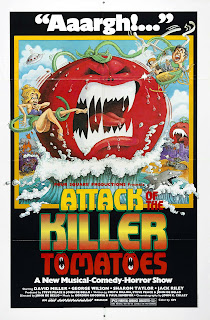
This right here and now is my call to action for you: Be the crafty rebel! Rebel against all that keeps you from watching the good movies and the bad movies, the colors and the b/w's, the sounds and the silents. Strive to watch and study Lawrence of Arabia as much as Attack of the Killer Tomatoes ... but be crafty about it. You don't have to become an anti-social prick in order to do it. Pick early mornings when the family's still asleep and watch The Asphalt Jungle. Steal an hour and a half when everyone's busy doing something else and catch Breathless. And, heck, get up in the middle of the night to shiver through Dracula has Risen from the Grave! Then there's books - you know, them darn things with more than 110 pages. Next time before you start in on one, think to yourself - how many movies could I watch instead of reading this whale? Talk about whale - watch Moby Dick instead of reading it!

You're a screenwriter. With everything tearing at you every single day of your life, you need to fight to spend quality time in your screenwriting world - and that quality time is more than writing. WRITE, READ, WATCH - as much as you can. The more movies you watch, the better you become at spotting structure, layers, arcs - and the stumbles and falls. With every single minute you spend INSIDE films, you do give yourself the chance to become a better writer. So - again - be the crafty rebel - watch movies!

11 February 2012

Deadlines - treat them with tender loving care

I do love deadlines - call me nuts, but I do. They give me drive and a clear frame, they give me the challenge and the goal. I may have mentioned it a few thousand times in past blogs (and I'll continue to do so) - screenwriting is part of an industry, a business. Just like good writing, deadlines, too, are chances for us to prove that we're worth the trust others have sent our way.

Yep, exactly - kick deadlines.
I've been hired a bunch of times. Of that bunch eight gigs have been produced. Of that same bunch many more have never seen the screenlight. And quite a few were also promises onto myself - spec scripts. I've had deadlines on all of them and I delivered on all of them. With 20 years of deadline experiences, I thought I might put down a few thoughts:
  • Personal deadlines: Yes, getting hired is tough - call it luck, call it the right moment, call it what you will - most writers never manage to get paid for the passion they put to paper. But passion it is, it's all you have - keep at it and give yourself deadlines - stick by them, no excuses. They force you to train your writing muscle, every day - the personal deadlines prepare you for the moment that business door opens.
  • Business deadlines: There's no standard, period. Proposals, treatments, 1st drafts, etc. - there's all sorts of time frames - deadlines vary greatly. In my experience producers are by nature pushy - they hire you and want something soon. But they also want something good. So, whether alone or with the aid of an agent - push back, politely and firmly. Demand the time you need to deliver good work - but at the same time, push yourself. Settle on deadlines that are both possible and challenging.
  • Delivery on deadlines: Do-not-deliver-early. I've done it a few times when I started out. You know what happens? You end up doing more vastly creative rewrites because heck, there's all that extra time all of a sudden. Too much time is bad for both the writer and the producers - it doesn't focus the mind, it lets it meander. So stick to the agreed deadlines, deliver 2 or 3 days early, sure - but no more. 
  • Producer pressure: The production side always wants it before they can have it. Professionals deserve to be treated like professionals. That cuts both ways. This is about the usual hurry-up-and-wait. You know that's going to happen - you'll bust your balls to beat the deadline - you deliver on time - and then you wait. A week later you'll make a call and find out that the person who wanted the script that urgently is off on holidays for three weeks. Basically, don't buckle under pressure, stick to your deadline - nothing else matters.
  • Don't forget life: I've had to learn that the hard way - goes with what I've just mentioned about the holidays. You have a life, you may have a family, places to go, things to do ... don't forget to figure those into the deadlines you'll suggest. Just as producers will take their vacation when they're good and ready - so should you. Plan them into your deadlines and you won't only have the time to write a great script and come out looking like a pro at the end - you'll still have the time to be a human being between now and then.
That's about it on the topic, I'd think ... maybe one final thought on the actual word. The term "deadline" was first used on prisoners during the Civil War. The deadline was a real line drawn in the dirt and prisoners would get the warning: "If you cross this line, you're dead." Luckily, the deadlines we're faced with these days are slightly less existential - odds are, nobody's going to kill you, should you ever miss one (not that you ever will, right?). 

04 February 2012

To Drive or not to Drive

This isn't a review. But sometimes, when I watch a movie that has been as tremendously hyped and lauded as Drive - and end up not being half as thrilled - it gets me wondering. "Screenwriter me" and "audience me" want to understand why it didn't click for us.

Yeah, I'm wondering, too.
The film is everything the reviewers proclaim it to be, it's exceedingly stylish, it's all around beautifully shot with those intense 80s colors. Ryan Gosling gives a wonderfully brooding performance - he doesn't need words, he's got Steve McQueen charisma to spare. So the plot is pretty standard crime-gone-wrong fare with a few mafia dudes and people that need to be "taken care of" - I don't mind. So this expert driver doesn't actually make much use of his one super-great expertise and instead of a car he relies on foot, hammer, shotgun, metal rod and some such to solve problems - I can still live with that.

And I generally appreciate films where I can bathe in the filmmakers obvious passion for film making. Tarantino flicks work that way for me - I may not always agree with his choices - but the sheer joy for film making that oozes from his choices is usually worth the ticket alone. In Drive, Nicolas Winding Refn, clearly shows that passion and splashes it with that type of joy. But where, in a Tarantino flick, you get great characters or, in a Guy Ritchie flick, you get it all with a wink - in this film that part simply doesn't work ... unfortunately, I believe, it all comes down to character.

Drive's "man with no name" isn't a sociopath - although he certainly does act like it a few times. That leaves us with him being a psychopath. Which is, per se, entirely fine - I don't mind a film with a good psychopath lead! But the character needs to work - even if you don't reveal a back story, even if you don't explain the shit out of your character - the character needs to make sense in the context of the story, of the world he's in. This man with no name isn't making any sense. Why is he here? Why does he drive? Why does he moonlight as a getaway driver (and work as a mechanic and stunt driver)? To live in a crappy apartment? Why does he need the money? What does he do with the money? Why does the man who's obviously quite smart do what he does? So he has a heart, likes the kid, like the kid's mom - why the vicious elevator kill right in front of her eyes? What's his plan? I guess - from a screenwriter's point of view you'd end up saying "What does he want?" and "What does he need"?

I'll give you another "man with no name" - Clint Eastwood in Fistful of Dollars (actually, that famous man with no name was called Joe). Eastwood played another man with no backstory, a surely coldblooded kinda guy who merrily kills left and right. But Leone doesn't give you his man with no name as a sociopath or psychopath - he gives him straight-forward purpose - he's in it for the money. Late in the game you'll learn he actually also has a heart, a single moment, a single line is enough - but it allows us embrace the character more fully. 

To me, what my Drive dilemma comes down to is this - IF the psychopath character was to be played as it has been, it should have made sense and that can only happen if the script gives the audience something to generate that sense. That didn't need to be cliche back story and morose monologues - but something, anything, a glimpse, a hint. One way to go might have been this: I would have loved to see this psycho character, with his obvious affection for mother and son, trying to hide his psycho streak from them - a lovely conflict, a hope of redemption, a glimmer of a life together ... all goes bust, of course - but I would have gone with the character, I would have rooted for him, I would have hoped with him. As is, I just watched him, great stares, nice style, lovely white satin jacket and that golden scorpion ... lots of style over emotion, unfortunately.

Alrighty then, I would expect there to be some serious hammer bashing coming up. With a whopping 93% on the Rotten Tomatoes meter, I must be wrong ... right? So bring on your comments! ... oh, before you start bashing, I just checked "A Fistful of Dollars" - Rotten Tomatoes has it at 98%, so there.