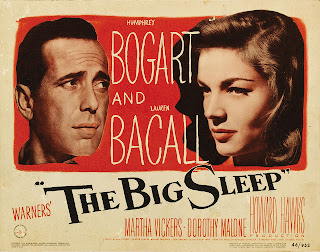
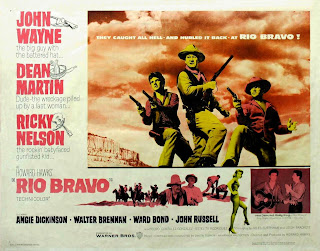
"The Big Sleep" and "Rio Bravo" will always be among my top ten films of all times. Everything clicks. A brilliant outcome from a collaboration of first-rate pros led by Howard Hawks. The scripts was penned by Leigh Brackett and Jules Furthman. As did some research for a post about Rio Bravo, I discovered more and more about what must have been a very special friendship between Brackett and Hawks. So here's a post about this instead!
Someone will spot this article and think - hey, there's a great biopic in here - and I'll be the first to agree. Fascinating times in Hollywood, larger than life stars - an elder man (Hawks) and an upcoming woman writer (Brackett) who would work together on classics like The Big Sleep, Rio Bravo and more. And enduring friendship in a cut-throat town. Do we have bad guys in this stories - oh yeah, there's a few up for grabs!
Leigh Brackett was born in LA in 1915. She was an only child, her father died when she was little. She was raised by her mother and grandparents in Santa Monica. Without delving deeper, I could already see story potential of a young woman very comfortable around older men. Was Howard Hawks such a father figure? I bet she wouldn't have agreed.
She was an early reader and started writing when she was thirteen. In an interview she says that it seemed the only thing to do - a good way to make a living.
Edgar Rice Burroughs'
Gods Of Mars
opened the world of science fiction for her. She was sold and sci-fi remained her great love
throughout her life. She met
Ray Bradbury and
Robert Heinlein, she joined the LA Science Fiction Society and published her first story "
Martian Quest" in 1940.
In her own words:
"I did have a knack for science fiction, which I dearly loved, so for quite a while I wrote nothing but science fiction. I was never a quantity producer and it was a very small field. Inasmuch as I had some financial responsibilities, I had to broaden out so I took to writing detective stories. I wrote quite a few of them for the pulp magazines. Then at long last I wrote a novel, which was perfectly frightful, and I couldn't say that it set any worlds on fire, but I loved it. It was my child, my first born, full-length novel."
Her first novel "
No Good From a Corpse" (1944) focused on a hardboiled detective determined to clear an innocent man of the murder of his girlfriend. In an interview Brackett shared that a friend of hers had worked at the bookstore where Howard Hawks would show up every couple of weeks to get a stack of thrillers. Her friend made sure that Brackett's novel was part of that stack - and that's how one of Hollywood's very special relationships began. Hawks got his agent to contact Leigh Brackett's agent. He basically said "I want to talk to that Brackett guy."
In her words:
"... my agent rang me up and said, "Howard Hawks wants to see you." I fell on the floor. I went to Warner Brothers for an interview and started to work on "The Big Sleep" and we got a contract for two and one half years then."
Yes, Hawks was expecting to meet a man - quite a natural assumption as "Leigh" can cut either way. Plus - what woman would write a tale of a hard-boiled detective? Apparently, Hawks wasn't that impressed by the story - but all the more so by the dialogue. Clearly a talented writer who might be just right to come on board for the screen version of Chandler's "The Big Sleep".

So she showed up - a 28 year old woman with barely any screenwriting experience (she did work on "
The Vampire's Ghost" the previous year) in a business mostly run, driven, crafted, powered by men. The fact that she and Hawks instantly got along and started a professional partnership that would last through the years speaks volumes about them. Hawks himself was, at that time, 62 years old. But maybe equally interesting - she would be teaming up with screenwriter Jules Furthman who was also getting up there - he was nearing his 60th birthday. Furthman was, at that time, slowing down, judging from his IMDB credits (a whopping total of 119!). And now he'd work with this woman wannabe writer whom Hawks seemed to like? Now that must have been an interesting situation, right?
Let me be clear here - I've listened to an
interview with Leigh Brackett and she's adamant that her being a woman was never an issue - that she did not have to fight left and right. On the contrary, that she was part of a small empowered team. They worked personally for Hawks and didn't have the same tight regimen as regular studio staff writers.
In her words:
"I was very fortunate, I think, because I was never under contract to the studio. I was under contract personally to Howard Hawks and Charles Feldman of H-F Productions, which dissolved about two and one-half years later and I got dissolved along with it. I never had to go through the business of checking out and all that. I came in through the side gate. Hawks had his own bungalow, whereas so many of the people who were under contract to the studio were working in sort of a barracks and they were checked in and out."
Fast forward to the mid fifties. Brackett was always writing and never got sucked into the Hollywood rat race. She was very much her own woman and stayed true to her first love, science fiction (something that would much later bring her further glory as she was the one who delivered the first draft of "
Star Wars Episode V: The Empire Strikes Back". Hmn... older man - makes me think whether there's a connection with the Yoda character (Yoda was initially called Minch, by the way) - who knows, right?!
I've read that Hawks and Brackett had a lot in common:
"They shared the same literary taste, she was sophisticated, dressed in somewhat outdoorsy manner, which the director liked, and she had spent much of her childhood in Pasadena, not far from the Hawks home. Moreover, her portrayal of the spirit of comradeship was of the kind that appealed to him. "There's probably no stronger emotion than friendship between men," Hawks once said."
Now then, was Brackett given equal treatment. Let's take the situation with Jules Furthman. In 1957 Howard Hawks paired the two again to collaborate on "Rio Bravo". Furthman was seventy at that point. Brackett apparently did more of the writing and received a weekly paycheck of 600 bucks. Furthman received a weekly 2500 for his thoughts (I've read he hated putting things on paper ... go figure!).
In her words:
"I don't like to say this, because it sounds presumptuous, but Hawks and I kind of tuned in on the same channel with regard to the characters, and I think this is probably one reason that I worked with him so long. He was able to get out of me what he wanted because I had somewhat the same attitude towards the characters as he did."
After the phenomenal success of Rio Bravo, the partnership with Howard Hawks and John Wayne continued and Brackett worked on Hatari, El Dorado and Rio Lobo with them. Rio Lobo (1970) was their final collaboration and Hawks' final film - he died in 1977. Brackett continued to work in film - most notably with Robert Altman on The Long Goodbye and, as already mentioned, she topped off her screenwriting work with Star Wars Episode V: The Empire Strikes Back.
Leigh Brackett and Howard Hawks, wherever they are, may the force be with them. And if the force isn't, I'm sure at the very least John Wayne is.

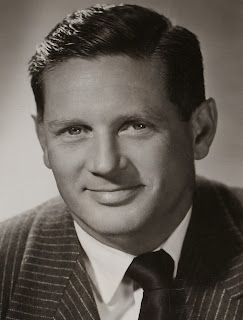
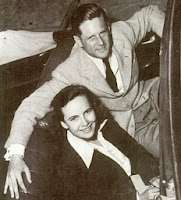
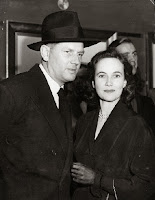 Theresa Wright was a major star then - and Niven Busch's wife. You see - Busch wasn't afraid to mingle. He was a dandy and a smooth talker and came across more like a movie star than the guy one traditionally envisioned behind a typewriter.