How often does a screenwriter get to script a genre-defining piece? And how often does that happen to the same one writer in two different genres? Well, it did and the screenwriter, Daniel Mainwaring (1902-1977), is pretty much forgotten today.
Which two genre-defining movies, you may ask? He's responsible for the novel and adaptation of film noir classic
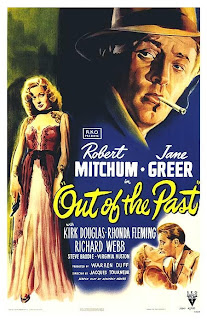
Out of the Past (written under the pseudonym Geoffrey Homes and remade in 1984 as Against All Odds) and sci-fi classic
Invasion of the Body Snatchers (written under his own name and directed by his pal Don Siegel - and remade twice by now).
Born in 1902 in Oakland, California, it seems writing was always in his heart. He started out as a newspaper reporter for the San Francisco Chronicle. (Elsewhere I've seen written that he'd worked for the Los Angeles Examiner in the early twenties. Well, whether LA or Frisco (or both), he covered the city's crime beat, something he was particularly good it, it seems. I've read that he brought his experience as a former PI to the job.
So how does a former PI turned reporter turn in two genre masterpieces? You move to Hollywood, of course!
At the age of 32 he published his first crime novel. And churned them out after that - several of them centered around a former reporter turned PI (write what you know and all that, I guess!). He said
"In 1935 I got my first job in the industry as a publicity man at Warner Brothers. Working in publicity you got to see and learn more about picture making than the writers did. . . . I didn't escape from the publicity racket until 1943."
He says he started out writing screenplays for Paramount and was happy to forget all of them except for Big Town. After having focused solely on screenplays he took a break to write another novels - it was Build My Gallows High - the blueprint for Out of the Past. Bill Dozier, head of RKO read it, bought it and Daniel Mainwaring with it. One thing that apparently clinched the deal was the gimmick scene in the novel where the mute boy uses his fishing rod to cast a hook and pull the bad guy to his death - the producers loved that scene and could just picture it.
 |
| Mainwaring & Bogie |
Out of the Past, directed by Jacques Tourneur, starred Robert Mitchum, Kirk Douglas, Jane Greer and Rhonda Fleming. Initially, Mainwaring had actually personally taken the script to Humphrey Bogart. According to Mainwaring, Bogie wanted to do it, but Warner Brothers wouldn't let him. Possible that Warner Brothers was still pissed off because in 1945 they had bid for the not-yet-published Build The Gallows High, too - and lost to RKO. So, with Bogie out, RKO then considered
Pat O'Brien, then
John Garfield was connected with the project, later
Dick Powell was announced as the film's star. And even
Lex Barker was tested for the role ... Well, luckily things happened as they did and finally Mitchum came into the picture.
In an interview, Daniel Mainwaring was asked about other writers involved in the adaptation of Out of the Past:
"I wrote the first draft, and Duff (producer Warren Duff) wasn't sure about it. All I had done were those pictures for Pine and Thomas (for Paramount). When I finished and went on to something else, Duff put Jim (James M.) Cain on it. Jim Cain threw my script away and wrote a completely new one. They paid him $20-30 thousand and it had nothing to do with the novel or anything. He took it out of the country and set the whole thing in the city. Duff didn't like it and called me back. Frank Fenton had worked on it for awhile. I made some changes and did the final. But that's the way things used to work. You'd turn around and spit and some other writer would be on your project."
In his take on Out of the Past, Roger Ebert has a bit more information. He refers to critic Jeff Schwager who read all the various drafts. Schwager agreed that the Cain was bad, but that Mainwaring's first draft wasn't that good either. He says that the great dialogue actually came from Frank Fenton. Well, be that as it may - movie making is collaborating!
Now about Invasion of the Body Snatchers. Mainwaring had met Don Siegel way back when he was still working as a publicist. At that point Siegel had been an aspiring director.
Something you see again and again - a writer's career often grows as the network's career grows. Focus on people at your career stage - work with them and grow with them. It certainly worked for Daniel Mainwaring. He worked with Siegel on The Big Steal in 1949 (it was basically RKO trying to capitalize on the success of Out of the Past - same stars, same writer). Mainwaring and Siegel collaborated four more times and their biggest success was of course Invasion of the Body Snatchers.
Invasion of the Body Snatchers (1956) was remade in
1978 and
1993 and when you look at it, it certainly brings together elements from Mainwaring's life. The whole "aliens taking over" aspect can certainly be seen as a play on the
communism witch hunts, being outcast, losing one's identity. Mainwaring was right there during that dark time in screenwriting history. But Invasion of the Body Snatchers certainly also has a film noir feel - watch it again, you'll see what I mean.
So next time someone mentions either of these two films, you may remember Daniel Mainwaring ... as you should - know your world (screenwriting principle #6).